


Table of Contents
- What Is an AI Call Center?
- How AI Call Center Technology Actually Works
- The Real Benefits of AI Call Center Solutions
- AI Call Center Use Cases by Industry
- AI Call Center vs Traditional Call Center
- How to Choose the Right AI Call Center Software
- AI Call Center Trends Worth Watching
- Bringing It Together with Whippy
- Frequently Asked Questions
Try Whippy for Your Team
Experience how fast, automated communication drives growth.
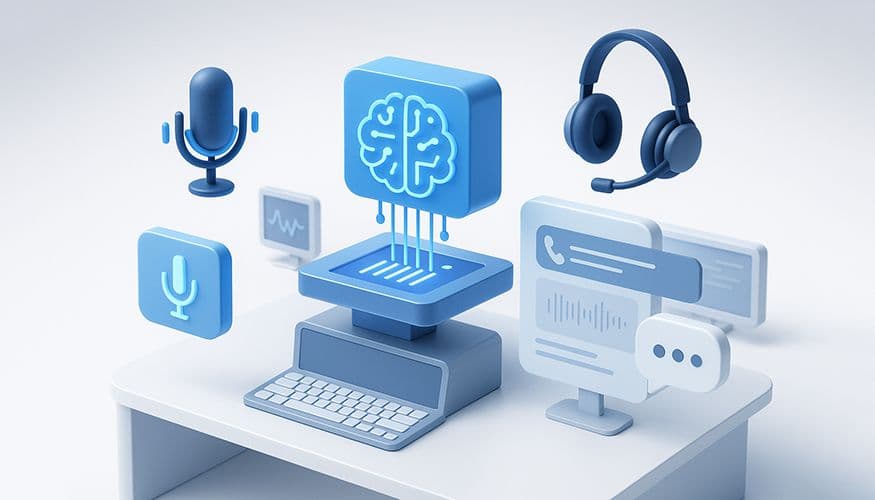
An AI call center uses artificial intelligence, including voice recognition, natural language processing, and machine learning, to automate phone conversations, route calls intelligently, and support live agents in real time. Instead of relying only on scripts and hold music, modern AI call center software understands what a caller wants, resolves routine requests on its own, and hands off complex cases to a human with full context already attached.
That shift is why so many teams are searching for AI call center solutions right now. Call volumes are up, staffing is expensive, and customers expect an answer in seconds, not minutes. Gartner projects that conversational AI will cut global contact center agent labor costs by $80 billion by 2026, and Zendesk's CX Trends research puts median tier-one deflection above 40% across enterprise support programs already running AI. This guide breaks down how AI call center technology actually works, what results you can realistically expect, and how to evaluate a platform before you buy one.
What Is an AI Call Center?
An AI call center is a customer service operation where artificial intelligence handles some or all of the work traditionally done by live phone agents. This includes AI voicebots that answer calls, AI conversational agents that carry multi-turn conversations, and AI call center analytics that turn every interaction into usable data.
It is not about replacing your team. The strongest AI contact center setups blend automation with human judgment. AI handles the repetitive, high-volume work: verifying an account, checking an order, confirming an appointment. Agents step in for the calls that genuinely need empathy, negotiation, or complex problem-solving. That division of labor is what actually moves the needle on AI call center performance, rather than automation for its own sake.
How AI Call Center Technology Actually Works
Most AI call center platforms are built on four connected layers. Understanding them makes it much easier to compare vendors instead of buying based on a demo alone.
AI Voice Recognition and Speech-to-Text
AI voice recognition converts spoken audio into text the system can act on. This is the same underlying AI speech recognition that powers call center voice AI more broadly, and it is what lets a system understand a caller regardless of accent, background noise, or phrasing. Paired with AI voice transcription, this creates a searchable record of every call, which is useful for compliance, coaching, and quality review. A caller does not need to speak in a specific way or use a menu of commands. They just talk, and the system listens the way a person would.
Natural Language Processing and AI Conversational AI
Once speech becomes text, AI conversational AI interprets meaning, intent, and tone. This is what separates a real AI voice assistant, or a broader AI virtual assistant handling both calls and chats, from an old-fashioned touch-tone menu. The system can detect frustration, understand a rephrased question, and keep track of context across a multi-turn exchange. AI conversational agents built on this layer can hold a natural back-and-forth instead of forcing callers down a rigid script.
AI Voicebots and Virtual Agents
AI voicebots and AI-powered voicebots are the front line of most deployments. A well-built AI virtual call center agent, like Whippy's Voice AI, can verify identity, look up account details, schedule appointments, take payments, and answer FAQs, all without a human on the line. For AI inbound call center use, that means faster resolution. For AI outbound call center use, it means proactive outreach, appointment reminders, and lead qualification that runs without waiting on staff availability. If you want a closer look at how voicebots specifically handle tier-one support, this breakdown of the best voice bot for customer support is worth a read.
AI for Call Routing and Intelligent IVR
AI for call routing replaces static phone trees with decisions based on real context: caller history, stated intent, and even detected sentiment. A frustrated repeat caller with an open issue can be routed straight to a specialist instead of starting over. This is one of the fastest ways to cut average handle time without adding headcount.
The Real Benefits of AI Call Center Solutions
The appeal of AI call center solutions is not automation for its own sake. It is what that automation does to cost, speed, and consistency in an AI-driven call center or a more traditional AI-powered call center layered onto an existing team. Here is where the impact actually shows up.

Efficiency and productivity: AI call center efficiency comes from removing repetitive work from human queues. When routine questions are resolved by a voicebot before an agent ever picks up, average handle times drop and AI call center productivity rises without extra hires.
Lower operating costs: AI call automation runs around the clock without overtime, night shifts, or seasonal hiring. That scalability matters most during demand spikes, when a traditional team would need to scramble to keep up. Gartner also expects agentic AI to autonomously resolve the large majority of common customer service issues by 2029, which is a strong signal of where deflection rates are headed industry-wide.
Better customer experience: AI customer experience improves when callers get answered immediately, in a natural conversation, at any hour. Combined with AI customer engagement tools that pull in prior interaction history, responses feel personal instead of scripted.
Sharper decision-making: AI call center analytics and AI-powered speech analytics turn thousands of calls into pattern recognition: recurring complaints, script effectiveness, sentiment shifts, and compliance gaps. Those AI-driven customer insights let managers fix root causes instead of reacting call by call.
Stronger agent performance: AI does not sideline your team, it supports them. Real-time prompts during a live call can flag a required disclosure or suggest a next step, which measurably improves AI call center performance and shortens onboarding time for new hires.
Together, these are the AI call center benefits that show up on a P&L, not just in a sales deck.
AI Call Center Use Cases by Industry
AI customer service automation applies differently depending on the industry, but the underlying pattern is the same: automate the predictable, escalate the exceptional.
- Healthcare: appointment scheduling and reminders, prescription refill requests, and intake calls handled through AI customer support automation, with sensitive data managed under strict compliance controls.
- Retail and e-commerce: order status, returns, and AI outbound call center campaigns for restocks, promotions, and win-back offers.
- Financial services and insurance: identity verification, payment reminders, and claims status updates that need to be fast and auditable.
- Staffing and recruiting: AI conversational agents that screen candidates, confirm interview times, and follow up automatically, freeing recruiters to focus on placements instead of phone tag.
- Utilities and government services: billing reminders, outage updates, and survey automation at a scale live teams could never sustain alone.
These AI call center use cases share a common thread: the goal is not to remove people from the process, it is to remove friction from it.
AI Call Center vs Traditional Call Center
FACTOR | TRADITIONAL CALL CENTER | AI CALL CENTER |
|---|---|---|
Availability | Business hours only | 24/7 |
Response time | Minutes, often longer during peaks | Seconds |
Personalization | Limited to what the agent recalls | Pulled from full interaction history |
Scalability | Bound by headcount | Scales instantly with demand |
Insight generation | Manual review, sampled calls | Every call analyzed automatically |
Cost structure | Grows linearly with volume | Automation absorbs volume spikes |
This is why AI-based call center platforms and AI-powered contact center platforms are becoming the default for teams that outgrew spreadsheets, shared inboxes, and static IVR menus. Whether you call the category call center AI solutions or contact center AI solutions, the underlying shift is the same: decisions move from static scripts to real-time, data-backed automation.
How to Choose the Right AI Call Center Software
Not every AI contact center software is built the same way, and the differences matter more once you are past the pilot stage. When evaluating AI call center platforms, look closely at:
- Voice automation quality. Does the AI voice automation sound natural, handle interruptions, and recover gracefully when it misunderstands something?
- AI call center integration. Your platform should connect cleanly with your CRM, helpdesk, and existing phone or SMS systems, not sit beside them as a separate silo. Whippy's full list of integrations shows how deep that connection can go without a custom build.
- Analytics depth. Real AI call center analytics go beyond call length. Look for sentiment detection, compliance tracking, and trend reporting you can act on the same day.
- Compliance and security. For regulated industries, HIPAA, SOC 2, and GDPR readiness are not optional extras. Whippy, for example, holds SOC 2 Type II certification, confirming its security practices and policies meet that standard.
- Multichannel reach. The best AI contact center solutions unify voice, SMS, and chat so customers never have to repeat themselves across channels.
- Speed to launch. Some AI-enabled call center tools take months to configure. Others can be live in weeks with pre-built workflows.
Beyond features, pay attention to how the vendor talks about their own AI call center tools. If every answer to a hard question leads back to "book a call with sales," that is usually a sign the platform is not as self-serve or transparent as it should be.
If you are comparing the best AI call center software on the market, this checklist is a faster filter than any feature list, because it tells you how the platform behaves under real conditions, not just what it claims to do.
AI Call Center Trends Worth Watching
AI call center modernization is moving fast, and a few shifts are worth tracking closely:
- Proactive outreach over reactive support. AI in outbound calls is shifting from cold campaigns to timed, context-aware nudges: renewal reminders, billing alerts, and win-back sequences triggered by behavior, not a calendar.
- Sentiment-aware routing. AI in customer engagement increasingly uses real-time emotion detection to flag at-risk conversations before they escalate.
- Unified voice and text journeys. Customers move between a phone call and a text message mid-conversation, and the best platforms preserve context across both.
- Agent copilots. Rather than fully autonomous bots, more deployments pair AI voicebots with live agents who get real-time suggestions, which raises quality without removing the human layer entirely.
These AI call center trends point in one direction: less rigid automation, more contextual, human-like interaction backed by data.
Bringing It Together with Whippy
Whippy brings voice, SMS, and chat into one AI-powered contact center platform, so your call center analytics, automation, and agent workflows live in the same place instead of scattered across tools. Whether you need an AI virtual call center agent for inbound support, automated outbound campaigns, or deeper visibility into every conversation, the goal is the same: faster resolutions without sacrificing the human touch customers still expect.
If you are exploring AI call center solutions for your team, the fastest way to see the difference is to watch it work on real calls. Request a live demo and see how Whippy's AI call automation, routing, and analytics fit into your existing workflow.
Voice is usually just one piece of a bigger picture. If your team is also rethinking chat, SMS, and email support, this complete guide to automating customer support covers the same framework across every channel, not just the phone.
Frequently Asked Questions
Q: What is an AI call center?
A: An AI call center uses artificial intelligence, including voice recognition, natural language processing, and automated voicebots, to handle customer calls, route inquiries, and support live agents without replacing them entirely.
Q: How is an AI contact center different from a traditional one?
A: An AI contact center can operate 24/7, resolve routine requests instantly, and analyze every conversation automatically, while a traditional call center is limited by staffing hours and manual review.
Q: Can AI really handle outbound calls, not just inbound support?
A: Yes. AI outbound call center tools can qualify leads, send appointment reminders, run renewal campaigns, and follow up on missed calls without waiting for an agent to be free.
Q: Will AI call center software replace human agents?
A: Not for complex or emotionally sensitive conversations. Most deployments use AI to absorb repetitive tasks so agents can focus on higher-value interactions, which improves both speed and quality.
Q: How long does it take to implement an AI call center platform?
A: Timelines vary by scope, but many AI call center integrations with existing CRM and phone systems can go live within a few weeks using pre-built workflows.
Q: What should I look for in AI call center analytics?
A: Beyond call volume and duration, look for sentiment detection, compliance tracking, and trend reporting that surfaces recurring issues automatically instead of requiring manual review.
Q: Is AI call center technology secure enough for regulated industries?
A: Reputable platforms support compliance frameworks like HIPAA, SOC 2, and GDPR, with encrypted transcription and call data handling built in rather than added on. Whippy, for instance, holds SOC 2 Type II certification confirming its security practices meet that standard.
Table of Contents
Table of Contents
- What Is an AI Call Center?
- How AI Call Center Technology Actually Works
- The Real Benefits of AI Call Center Solutions
- AI Call Center Use Cases by Industry
- AI Call Center vs Traditional Call Center
- How to Choose the Right AI Call Center Software
- AI Call Center Trends Worth Watching
- Bringing It Together with Whippy
- Frequently Asked Questions
Try Whippy for Your Team
Experience how fast, automated communication drives growth.

Related Articles
EU AI Act: Whippy's Independent Bias Audit
 Elizabeth Long
Colorado SB 26-189: Whippy's Independent Bias Audit
Elizabeth Long
NYC Local Law 144: Whippy's Independent Bias Audit
Elizabeth Long
California FEHA: Whippy's Independent Bias Audit
Elizabeth Long
Illinois HB 3773: Whippy's Independent Bias Audit
Elizabeth Long
Best AI Recruiting Tools for Franchise Staffing
Elizabeth Long