


Table of Contents
- What Is AI Recruitment Software for Non-Staffing Companies?
- How to Choose the Best AI Recruitment Software: 8-Point Checklist
- AI Recruitment Software by Industry: What "Good" Looks Like
- How AI Recruitment Software Reduces Candidate Drop-Off
- 90-Day Implementation Roadmap for AI Recruitment Software
- Why Whippy Is the Best AI Recruitment Software for Your Industry
- Request a Demo today ↗
- Key takeaways
- FAQ
Try Whippy for Your Team
Experience how fast, automated communication drives growth.
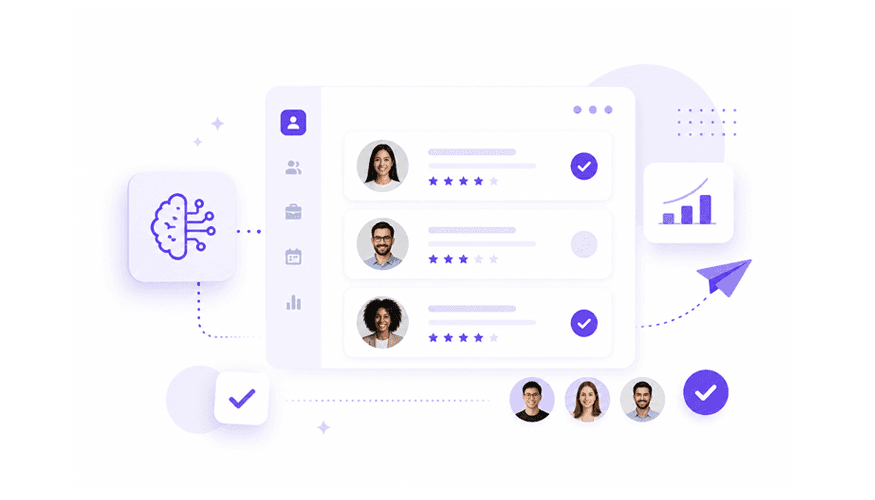
The best AI recruitment software for non-staffing companies combines AI-powered candidate engagement, resume screening, and interview scheduling with ATS/HRIS integrations. It helps reduce time-to-hire by up to 40%, prevent candidate drop-off, which affects 60% of applicants before they even complete a form, and keep teams fully staffed in industries like hospitality, retail, and healthcare.
Built on SOC 2 Type II-compliant infrastructure, the best platforms keep teams fully staffed in industries like hospitality, retail, and healthcare, without sacrificing compliance or candidate experience.
Non-staffing organizations often don’t think of themselves as “recruiters”, yet during peak demand they face the same challenges staffing firms do. Hotels need to cover shifts before guests arrive, retailers must replace high-turnover roles quickly, and healthcare providers can’t afford vacancies in critical positions. Seasonal surges, credential checks, and abandoned job applications, a common form of abandonment (application drop-out, put enormous pressure on hiring teams, leading to missed revenue, overworked staff, and poor customer or patient experiences.
This is where AI steps in. The best solutions go beyond generic applicant tracking software. They blend AI candidate engagement platforms, AI resume screening software, and AI interview scheduling software into one streamlined system. Strong platforms also layer in conversational AI recruiting (AI chatbots and voice agents), compliance safeguards, analytics, and industry-specific workflows. The outcome: faster hiring cycles, smoother candidate experiences, and fewer drop-offs, all without forcing non-staffing companies into staffing-agency workflows.
What Is AI Recruitment Software for Non-Staffing Companies?
AI recruitment software is a category of talent acquisition technology that uses artificial intelligence, including NLP, large language models, and conversational AI, to automate candidate sourcing, resume screening, interview scheduling, and engagement. Unlike traditional applicant tracking systems (ATS), AI recruitment software actively engages candidates, reduces drop-off, and makes data-driven hiring decisions at scale.
For hiring teams outside of staffing agencies, the ideal solution is not just another Applicant Tracking System (ATS) or generic applicant tracking software. Every additional day an open position remains unfilled increases cost-per-hire by an average of $98, making the speed advantage of AI recruitment software a direct financial imperative, not just an operational preference.
Here's how AI recruitment software compares to legacy tools:
Capability | Basic ATS | Generic Recruiting Software | AI Recruitment Software |
|---|---|---|---|
Resume screening | Manual | Rule-based filters | NLP + LLM parsing |
Candidate engagement | Email only | Email + SMS | Omnichannel + AI chatbot |
Interview scheduling | Manual | Semi-automated | Fully automated self-booking |
Compliance monitoring | Basic | Limited | Bias detection + audit logs |
Analytics | Basic reporting | Basic reporting | Predictive analytics |
High-volume hiring | ✗ | Partial | ✓ Native support |
Here are the core components every platform should have:
AI candidate engagement platform
Non-staffing recruiters need tools that engage candidates at scale without sacrificing personalization. AI chatbots, voice agents, and conversational AI recruiting can respond instantly to FAQs about pay, shifts, or qualifications, send reminders, and manage pre-screening. These tools don’t just live on a career site, they can extend across SMS, WhatsApp, and mobile applications, meeting candidates where they already spend time.
By nudging applicants to complete job applications, reminding them of interviews, or answering common scheduling questions, engagement tools directly address abandonment (application drop-out). The result is a smoother candidate journey that not only improves the candidate experience but also strengthens your employer brand by ensuring every applicant feels acknowledged and supported. With a clean User Interface and Adaptive UI, these systems keep workflows simple for recruiters while scaling outreach to hundreds or thousands of candidates at once.
AI screening tools for recruiting
Manual filtering slows hiring. AI resume screening software uses Natural Language Processing (NLP) and Large Language Models (LLMs) to parse CVs, surface critical qualifications, and highlight strong fits. Many systems also layer in pre-employment tests and evaluation rubrics, improving candidate matching and strengthening the talent pipeline, especially for credentialed roles.
AI interview scheduling software + AI interview assistant
Coordinating interviews is one of the biggest drains for hiring teams. AI interview scheduling software lets candidates self-book times that sync with recruiter calendars, while add-ons like an AI interview assistant or video interviewing modules provide consistent evaluations and structured data. Together with skills-based assessments, these tools ensure candidates progress smoothly through the interview process.
Taken together, engagement, screening, and scheduling modules not only reduce candidate drop-off but also improve overall candidate experience by giving applicants timely answers and clear next steps.
Applicant Tracking System (ATS) alignment
Most organizations already use some form of applicant tracking software, including applicant tracking software for healthcare businesses. The best AI solutions work as overlays or extensions, integrating with ATS, HRIS, calendars, and messaging systems, see Whippy’s integrations.
This ensures recruiters can continue to track candidates across the funnel while adding the intelligence of AI without overhauling existing workflows.
Analytics & fairness
Modern recruitment tools must deliver transparency. Dashboards powered by predictive analytics allow organizations to measure conversion rates, spot bottlenecks, and track improvements in time-to-hire. For industries with seasonal or event-driven demand, analytics can forecast upcoming spikes, giving hiring teams the ability to scale proactively rather than reactively.
At the same time, compliance features such as bias monitoring, audit logs, and fairness safeguards - supported by Whippy’s SOC 2 Type II compliance - ensure that hiring decisions are made on consistent, data-backed criteria. This not only reduces risk but also supports company-wide diversity goals by minimizing bias in screening and shortlisting. Beyond compliance, analytics empower hiring managers to take corrective action mid-funnel, for example, if candidate drop-off is highest after job postings, teams can refine messaging immediately rather than losing weeks of applicants.
Scale & fit
Finally, non-staffing companies require scalability. A true AI recruitment platform for large-scale hiring supports recruitment automation software for high-volume hiring, bulk communication, and location-based coordination. Built-in marketplace integrations (like background checks, assessments, or scheduling tools) and automations make it extensible without custom builds. Crucially, it must remain easy to use, with streamlined UX and workflows that reduce admin effort while maximizing recruiter productivity.
How to Choose the Best AI Recruitment Software: 8-Point Checklist
The best AI recruitment software for non-staffing companies scores high across 8 criteria: high-volume readiness, AI sourcing and screening, engagement automation, industry-specific templates, ATS integration, compliance and analytics, UX quality, and total cost of ownership.
Use this rubric to score vendors from 1–5 and prioritize features that directly affect candidate engagement, time-to-hire, and your ability to track candidates across the funnel.
1. High-volume readiness
The platform must handle peak hiring cycles with queue management, bulk actions, and elastic throughput. In industries like hospitality and retail where hundreds of job titles may need filling, performance cannot lag. True AI recruiting software should scale without bottlenecks.
2. AI sourcing & screening
Look for AI hiring tools that combine resume screening, AI sourcing, and talent matching. Systems should parse CVs, flag certifications, and surface role-fit signals. Bonus: platforms that add pre-employment tests or video interviewing help reduce bias and ensure fairer decisions.
3. Engagement & scheduling automation
Modern platforms should double as a talent engagement platform, with the ability to run targeted campaigns, offer AI chatbots, voice agents, SMS nudges, and mobile apply. At the same time, they should automate the interview process, self-booking, reminders, rescheduling, and standardized evaluations with an AI interview assistant. This blend improves candidate relationships while cutting drop-off.
4. Industry-specific templates
Generic systems rarely meet frontline needs. Choose AI recruitment software for retail and recruitment software for retail hiring that support multi-store workflows, hospitality hiring software with multilingual options, and hospitality recruitment automation tools or AI recruitment software for healthcare that validates credentials and ensures compliance. Ready-made templates speed up adoption.
5. ATS & systems fit
The right platform enhances, not replaces, your tools. Ensure integrations with ATS, HRIS, calendars, messaging, and background checks. Recruiters must be able to track candidates across systems without duplication, keeping the candidate pipeline clean.
6. Compliance, fairness & analytics
Trust is critical. Vendors should offer compliance controls, audit logs, and bias monitoring while providing predictive analytics and data-backed dashboards. You should be able to measure conversion by funnel stage, benchmark across job titles, and track time-to-hire improvements.
7. Admin & UX
Recruiters need intuitive UX, a clean User Interface, and Adaptive UI features that adjust for different devices or users. If navigation is clunky, adoption will falter. Look for balance: advanced functionality with simple, usable workflows.
8. Total cost & productivity
Finally, weigh licensing and integration costs against real gains. A platform that automates engagement, streamlines scheduling, and reduces admin work improves recruiter efficiency, strengthens the employer brand, and even cuts reliance on customer service staff by giving candidates timely updates.
💡Tip:
If your business faces seasonal spikes, focus on readiness, sourcing, and engagement. For regulated industries, prioritize compliance and analytics.
AI Recruitment Software by Industry: What "Good" Looks Like
While every company faces unique challenges, certain industries benefit
most from AI recruitment software due to high turnover, seasonal demand,
and compliance requirements. Here's how the best platforms perform in
hospitality, retail, and healthcare.
Hospitality: speed + schedule coverage
Hotels, resorts, and restaurants often need to scale their workforce quickly, especially during seasonal peaks or major events. Their challenge isn’t just finding candidates but ensuring shifts are filled in real time. Hospitality recruitment software and hospitality recruitment solutions with conversational AI recruiting can provide mobile-first applications, instant pre-screening, and even automated scheduling across multiple locations. Adding an AI hiring assistant for seasonal hiring makes it possible to process hundreds of applications within days.
This approach works because it removes barriers for candidates. By using AI chatbots to answer common questions and automating interview scheduling, hospitality businesses minimize drop-off. Candidates can self-select roles, confirm availability, and even complete basic pre-employment tests through the same interface. The result is faster onboarding, happier hiring managers, and better customer service for guests who rely on fully staffed teams.
Retail: conversion at scale
Retailers face high turnover and must constantly hire to keep stores staffed. The goal isn’t just sourcing candidates but converting walk-ins and mobile applicants into actual hires. AI recruitment software for retail, along with retail recruitment automation tools, helps by providing kiosk-style application systems, SMS follow-ups, and AI chatbots that answer pay and shift questions in real time. CRM (Candidate Relationship Management) tools log every touchpoint, helping recruiters track candidates across stores and regions.
This focus on engagement reduces abandonment, strengthens the talent pipeline, and positions the system as one of the most effective retail recruitment solutions for high-volume environments. More importantly, it improves company culture by ensuring hiring managers aren’t overwhelmed with administrative work. The system’s User Interface and Adaptive UI make it easy for even non-technical store managers to oversee the interview process and move candidates quickly to offers.
Healthcare: credentials + compliance
Healthcare hiring is about speed and precision. Mission-critical roles cannot sit empty, but compliance requirements mean every applicant must be thoroughly vetted. Healthcare recruiting software and healthcare talent acquisition software enhanced by AI can validate licenses, parse resumes for certifications, and ensure adherence to data privacy regulations.
For healthcare providers, AI recruiting tools for healthcare help surface qualified candidates faster while reducing errors that might compromise patient care. By incorporating pre-employment tests, structured interview processes, and even video interviewing, hiring teams can ensure they’re selecting talent that is both skilled and aligned with organizational values. This approach reduces liability, supports reducing bias, and strengthens company culture by promoting fairness and consistency.
How AI Recruitment Software Reduces Candidate Drop-Off
One of the most measurable benefits of AI recruitment software is its ability to combat candidate drop-off. 60% of candidates abandon job applications before completing them, with lengthy forms (50%) and missing pay information (31%) as the top two reasons. The drop-off gap by application length is stark: applications that take over 15 minutes to complete see a 3.61% completion rate, compared to 12.47% for those under 5 minutes.

Personalized pathways: Generative AI adapts prompts, FAQs, and workflows to align with job titles, job descriptions, and candidate profiles. This reduces confusion and improves clarity, making it less likely for applicants to abandon the process.
Instant answers: AI chatbots and voice agents handle repetitive candidate questions about pay, shifts, and schedules instantly. Organizations using recruitment chatbots report 30% lower drop-off rates and 65% higher candidate satisfaction scores, precisely because candidates who get immediate responses don't abandon the process in frustration.
Streamlined experiences: A clean User Interface, intuitive UX, and Adaptive UI reduce friction on mobile and desktop alike, giving candidates a smooth journey from application to offer.
Automated scheduling: AI interview scheduling software empowers candidates to book, reschedule, and confirm interviews at any time. This matters because 42% of candidates withdraw from hiring processes specifically because scheduling takes too long, a friction point that self-service booking eliminates entirely.
Sharper screening: AI resume screening tools process 75% more candidate applications than manual reviews and have reached 92% accuracy in resume screening as of 2024. The result is faster shortlists, more consistent evaluations, and less bias, since decisions are grounded in qualifications rather than subjective impressions.
By combining these elements, AI-driven platforms not only keep candidates engaged but also reinforce your employer brand. The net result: stronger pipelines, faster hiring, and a workforce aligned with your company culture.
90-Day Implementation Roadmap for AI Recruitment Software
Rolling out AI recruitment software doesn't have to be overwhelming.
A phased approach lets hiring teams build foundations, automate key
processes, and scale into advanced features, all while keeping your
existing recruitment software stack intact.
Days 1–15: Foundations
The first step is mapping your hiring process and aligning it with technology. Define the job postings you hire for most often, outline the job applications and qualifications required for each open position, and decide which pre-employment tests or assessments should be standardized across roles.
Next, connect your existing Applicant Tracking System (ATS) or other applicant tracking software to the new solution. This lets hiring teams keep familiar workflows while adding AI enhancements. It’s also the time to establish fairness and compliance standards, set bias monitoring thresholds, agree on what defines a qualified candidate, and ensure candidate relationships are protected as automation scales.
Days 16–45: Automating the funnel
With the framework in place, focus on automating the funnel. Launch an AI candidate engagement platform that uses conversational AI for volume hiring to pre-qualify applicants, answer FAQs, and keep the candidate pipeline moving. Activate features like an AI interview assistant and AI interview scheduling software to eliminate scheduling bottlenecks. Adding video interviewing provides flexibility and a consistent interview process, improving overall candidate experience.
During this stage, build dashboards to monitor performance. Use predictive analytics to track time-to-hire, identify funnel drop-offs, and measure candidate satisfaction. These diagnostics show where to optimize and confirm whether your system is delivering on expectations.
Days 46–90: Scale & optimize
By the final phase, your system should be handling resume screening, AI sourcing, and engagement. Now extend functionality with marketplace integrations such as background checks or payroll systems. Optimize workflows by re-weighting talent matching to surface the right qualified candidates and adjusting automation rules when bottlenecks appear.
At this point, also refine the career site UX, streamline job titles and application forms to reduce drop-offs. Finally, evaluate cultural alignment: AI should reinforce company culture by supporting fairness, transparency, and stronger candidate relationships. This ensures your investment in high-volume hiring recruitment tools builds long-term trust while scaling efficiently.
Why Whippy Is the Best AI Recruitment Software for Your Industry
If the criteria above describe what you're looking for in AI recruitment
software, here's how Whippy delivers each one in practice. Whippy is more
than a recruiting tool, it's a SOC 2 Type II-compliant talent acquisition
platform built specifically for non-staffing companies facing large-scale hiring. We help industries like retail, hospitality, and healthcare simplify the entire hiring process without sacrificing compliance or candidate experience.
For hospitality & retail: Whippy offers mobile-first career sites, location-based routing, and intelligent hospitality hiring software and retail recruitment software templates. These streamline applications, reduce drop-off, and keep candidates engaged.
For healthcare: Our AI recruitment software for healthcare delivers secure credential parsing, structured evaluations, and embedded compliance features. This ensures every qualified candidate meets strict regulatory requirements before being advanced.
For seasonal peaks: With Whippy, you gain an AI hiring assistant for seasonal hiring that scales communications, scheduling, and pre-screening without overwhelming your hiring teams.
By combining AI sourcing, recruiting automation, and analytics, Whippy gives organizations the ability to track candidates throughout the funnel, reduce time-to-hire, and scale confidently, even during the busiest hiring cycles.
Ready to reduce time-to-hire with the best AI recruitment software for your industry?
See how Whippy's AI recruitment platform helps hospitality, retail, and healthcare teams hire faster, reduce candidate drop-off, and stay compliant at scale.
Request a Demo today ↗
Key takeaways
- Think of AI recruitment software as a talent acquisition software layer over your existing ATS and HR systems. It should enhance (not replace) your recruiting process.
- Prioritize features that address your most pressing challenges: engagement, resume screening, scheduling, and talent matching. These are the areas where candidate drop-off is most common.
- Demand tools that can scale across industries. AI recruitment software for hospitality, retail recruitment software, and healthcare hiring solutions should be tailored to your sector’s realities.
- Look for platforms with strong UX, intuitive User Interfaces, and Adaptive UI so recruiters and candidates alike benefit from a smooth process.
- Ensure your chosen solution supports fairness, reducing bias, and compliance. This reinforces company culture while building trust with candidates.
- Don’t overlook long-term value. The best AI recruiting software not only fills open positions faster but also strengthens candidate relationships, improves customer service quality in frontline industries, and sustains growth by continually feeding a healthy candidate pipeline.
FAQ
Q: What is the best AI recruitment software for high-volume hiring?
A: The best platforms combine AI hiring tools for sourcing and screening, AI interview scheduling software for seamless coordination, and AI candidate engagement platforms that reduce candidate drop-off. They integrate with your ATS, support industry templates like recruitment software for hospitality hiring, retail recruitment software, and AI recruitment software for healthcare, and provide analytics to cut time-to-hire while scaling efficiently.
Q: How does AI improve hiring at scale for non-staffing companies?
A: AI strengthens the entire candidate pipeline by automating repetitive tasks like resume screening, candidate sourcing, and job applications follow-ups. It improves candidate experience by using Generative AI to adapt responses, ensuring fairness and reducing bias. For hiring teams, this means less time on manual work and more time building strong candidate relationships, strengthening the employer brand, and reinforcing company culture.
Q: Is AI recruiting compliant and fair?
A: Yes, when properly configured. The best recruiting platforms provide compliance features, bias detection, and audit logs. They ensure fairness by basing decisions on data-driven criteria such as qualifications, role requirements, and structured assessments, not subjective impressions. By reducing bias, organizations can create more diverse and equitable candidate pipelines across all jobs.
Q: How much does AI recruitment software cost?
A: AI recruitment software pricing varies by volume, features, and deployment model. Most platforms charge based on usage, such as number of candidates screened or conversations handled, rather than per recruiter seat. The real evaluation should focus on cost per completed screening and productivity gains, not license price alone.
Q: Can AI recruitment software replace human recruiters?
A: No. AI recruitment software is designed to automate high-volume, repeatable tasks such as screening, engagement, and scheduling. Human recruiters remain essential for judgment, relationship-building, and final hiring decisions. The goal is to remove bottlenecks, not replace recruiters.
Q: How long does it take to implement AI recruitment software?
A: Most modern AI recruitment platforms can be implemented in weeks, not months. Initial setup typically includes ATS integration, workflow configuration, and role templates. Many non-staffing companies see measurable improvements within the first 30 to 60 days, and the urgency is real: 65% of talent acquisition teams plan to increase AI investment in 2025, meaning delayed adoption is increasingly a competitive disadvantage.
Q: Does AI recruitment software integrate with existing ATS systems?
A: Yes. The best AI recruitment software integrates directly with Applicant Tracking Systems, HRIS platforms, calendars, and messaging tools. This allows recruiters to track candidates in one system of record while using AI to automate engagement, screening, and scheduling.
Q: Is AI recruitment software suitable for small or mid-sized teams?
A: Yes. AI recruitment software is especially valuable for small and mid-sized teams facing high applicant volume or seasonal spikes. By automating screening and coordination, smaller teams can handle hiring demand that would otherwise require additional headcount.
Q: How does AI recruitment software reduce candidate drop-off?
A: AI reduces candidate drop-off by providing instant responses, clear next steps, and flexible scheduling. Automated follow-ups, conversational AI, and mobile-friendly experiences keep candidates engaged throughout the hiring process, reducing abandonment and improving overall conversion rates.
Q: Which industries benefit most from AI recruitment software?
A: Hospitality, retail, and healthcare benefit most from AI recruitment software due to high turnover, seasonal demand spikes, and strict compliance requirements. In these sectors, CHROs report AI-driven recruitment has improved time-to-hire by more than 30%, while AI screening tools deliver up to 40% faster time-to-shortlist for volume roles.
Table of Contents
Table of Contents
- What Is AI Recruitment Software for Non-Staffing Companies?
- How to Choose the Best AI Recruitment Software: 8-Point Checklist
- AI Recruitment Software by Industry: What "Good" Looks Like
- How AI Recruitment Software Reduces Candidate Drop-Off
- 90-Day Implementation Roadmap for AI Recruitment Software
- Why Whippy Is the Best AI Recruitment Software for Your Industry
- Request a Demo today ↗
- Key takeaways
- FAQ
Try Whippy for Your Team
Experience how fast, automated communication drives growth.

Related Articles
Whippy Earns Unbiased Hiring Certification by Warden AI
 Elizabeth Long
Write Job Descriptions That Make AI Recruiters Perform
Elizabeth Long
Payroll Communication for Staffing Agencies
Elizabeth Long
Automated Employee Call-Off System for Staffing Firms
Elizabeth Long
Automate Candidate Inquiries for Recruiting Teams
Elizabeth Long
AI Receptionist for Staffing Agencies (2026 Guide)
Elizabeth Long