


Table of Contents
- What are the leading voice AI platforms for health insurance call centers?
- Why Voice AI is becoming essential in health insurance call centers
- Voice AI platforms vs traditional call centers: what has changed?
- What “leading” really means in Voice AI for health insurance call centers
- Core capabilities of leading Voice AI platforms for health insurance call centers
- 1) High-accuracy speech recognition (ASR) and conversation quality
- 2) Natural language understanding (NLU) and conversational AI
- 3) Low latency and natural pacing
- 4) Intent-based routing and smart escalation
- 5) Call recording + transcription for compliance and QA
- 6) Monitoring and analytics (with real business metrics)
- 7) Integrations that actually reduce work
- 8) Text-to-speech quality and control
- 9) Compliance readiness, consent, and safeguards
- 10) Reliability under load and minimized SLA gaps
- Insurance-specific Voice AI use cases that drive ROI
- Claims intake and claims status support
- FNOL-style capture for certain insurance workflows
- Payments and billing support
- Policy updates, plan changes, and renewals
- Provider search and routing
- Appointment scheduling automation and reminders (callbacks and service coordination)
- After-hours triage and call deflection
- Healthcare adjacency: where health insurance Voice AI overlaps with healthcare customer support
- How to choose the right platform for your health insurance call center
- What makes Whippy a leading Voice AI platform for health insurance call centers
- Avoid these common mistakes when deploying Voice AI in health insurance call centers
- Is Voice AI replacing IVR?
- FAQ: Voice AI for health insurance call centers
- The bottom line
Try Whippy for Your Team
Experience how fast, automated communication drives growth.
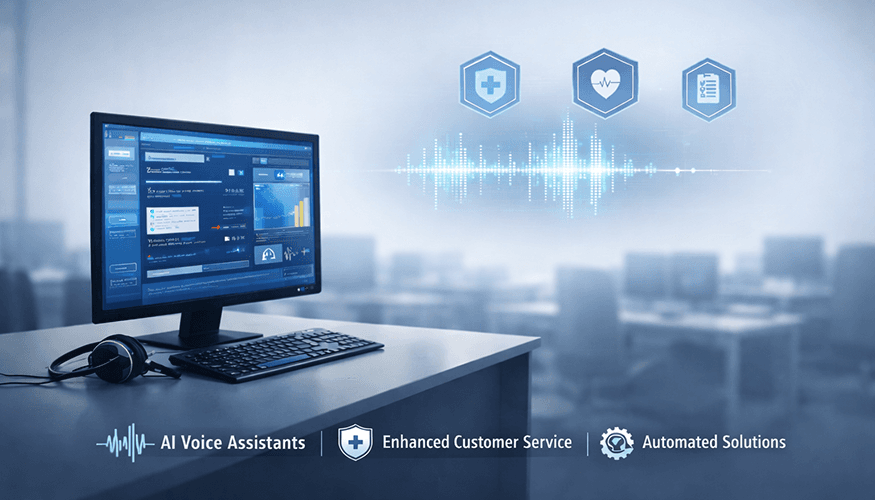
Health insurance call centers are under constant pressure. Members expect fast answers. Agents face high volumes, complex policies, and emotionally charged calls. During peak periods like open enrollment, even well-staffed teams struggle to keep up.
That is why the conversation has shifted from “should we use AI?” to which leading voice AI platforms for health insurance call centers can deliver real outcomes without creating new risk.
This guide breaks down what matters most, which capabilities define the best platforms, and how health insurance organizations can deploy Voice AI safely, quickly, and measurably.
What are the leading voice AI platforms for health insurance call centers?
The leading voice AI platforms for health insurance call centers use conversational AI to automate common inbound and outbound calls, handle routine member questions, support claims intake, route calls intelligently through intent-based routing, and escalate to live agents when needed. The best platforms combine high voice accuracy (ASR and speech recognition), low latency, compliance features, call recording + transcription (compliance + QA), monitoring and analytics, and integrations (CRM/EHR/contact center stack) to deliver measurable call center automation (voice AI) without compromising trust.
In practice, leading platforms excel at four things:

Accuracy: strong ASR and natural language understanding (NLU) for insurance language
Speed: low latency so calls feel human and responsive
Safety: escalation, guardrails, and compliance readiness for insurance workflows
Operations: analytics, monitoring, and seamless integrations into your existing systems
Why Voice AI is becoming essential in health insurance call centers
Health insurance member services is not like generic customer support. Every call has stakes. People call when they are confused, stressed, or financially impacted. At the same time, many calls fall into repeatable patterns:
- Benefits and coverage questions
- Eligibility confirmations
- Claims status updates
- Provider search
- Billing and payments questions
- Policy updates and plan changes
- Renewals and enrollment support
This is exactly where AI in insurance call centers is proving value: helping teams automate routine calls, reduce wait times, and let agents focus on exceptions and empathy. In many organizations, Voice AI is now being evaluated alongside medical insurance call center software as part of a broader modernization strategy for member support.
Two operational realities make Voice AI increasingly urgent:
1. Volume spikes are predictable, but staffing is not
2. Open enrollment, billing cycles, and policy changes create surges that overwhelm queues and increase abandonment.
3. Missed calls create repeat calls
4. Voicemail and after-hours gaps lead to higher repeat call volume the next day. A strong ai assistant reduces missed-call leakage by covering key intents 24/7.
It also explains why many teams searching for leading voice AI for healthcare call centers end up narrowing their selection to solutions that handle insurance-specific workflows, not just generic healthcare voice AI.
Voice AI platforms vs traditional call centers: what has changed?
A few years ago, most automation in call centers meant rigid phone trees and frustrating transfers. Today, the best systems act more like AI call center and phone agents and artificial intelligence call center agents that can listen, understand intent, and respond naturally.
When evaluating AI voice agents vs traditional call centers, three differences matter most:
1) Conversations, not menus
Members can speak normally, and the system uses natural language understanding (NLU) to interpret requests instead of forcing keypad input.
2) Structured outcomes
The platform can capture data, tag call reasons, create summaries, and trigger next steps.
3) Safe escalation
The system can route to agents immediately when the request is complex, urgent, or sensitive.
Example: Traditional IVR vs Voice AI
- Traditional: caller navigates menus → lands in wrong queue → transfers → repeats information
- Voice AI: “I’m calling about my claim status” → AI verifies → captures claim ID → provides status or escalates with a summary
This is why insurers and healthcare contact center leaders increasingly adopt Voice AI alongside human teams. It is not just IVR replacement. It is conversational triage that improves outcomes and experience.
What “leading” really means in Voice AI for health insurance call centers
The market is crowded with AI agent companies and contact center AI software platforms. Many look similar on the surface. “Leading” platforms consistently deliver performance across the full lifecycle: conversation quality, operational reliability, and measurable ROI.
A platform should be considered “leading” if it consistently delivers:
Accurate recognition and understanding (ASR + NLU)
Fast response times (low latency)
Reliable escalation and intent-based routing
Strong monitoring, reporting, and quality controls
Compliance readiness for insurance and healthcare workflows
Real integrations into the systems your teams already use
Reliability at scale with minimal SLA gaps (voice AI)
These are the same criteria buyers use when comparing the most reliable AI voice agents for insurance companies, especially in high-volume environments like health insurance call centers.
In short, the best voice AI platforms feel like a real operational layer of your contact center, not a demo.
A simple evaluation rubric
If you want a clear AI voice agent platforms guide, score vendors from 1–5 across:
- Conversation quality (ASR/NLU, error recovery)
- Latency and stability at peak traffic
- Containment vs escalation performance
- Compliance posture and auditability
- Monitoring solutions (healthcare call centers) and QA controls
- Integration depth (CRM, cases, reporting)
- Deployment speed and support model
- Cost predictability and measurable ROI
This approach helps avoid selecting generic voice AI platforms that are not built for health insurance call center realities.
Core capabilities of leading Voice AI platforms for health insurance call centers
Below is a practical checklist you can use for selection. This is also the feature set behind the best AI voice agent platforms, top AI voice agent platforms, and the best voice-AI companies for call-center automation.
1) High-accuracy speech recognition (ASR) and conversation quality
Your Voice AI is only as good as its ability to understand real members in real conditions. Leading platforms invest heavily in:
- ASR that handles accents, background noise, and fast speech
- Strong speech recognition accuracy for insurance terminology
- Clear audio handling and stable call performance
If your ASR is weak, every other feature becomes irrelevant. People will ask for an agent immediately.
2) Natural language understanding (NLU) and conversational AI
Modern call automation depends on:
- natural language processing (NLP) to interpret meaning
- natural language understanding (NLU) to detect intent and entities
- Strong conversational AI (call center context) that feels human
The best platforms also manage “repair” well. When the system mishears, it should ask clarifying questions instead of failing.
This is where ai models matter. Not all models behave the same, and “smart” is not enough. They must be tuned for safety and operational outcomes.
3) Low latency and natural pacing
Even a smart assistant can feel unusable if it responds too slowly. The best platforms keep latency (voice AI) low so calls feel fluid and professional.
Latency is one of the most overlooked reasons programs fail. If people experience delays, they assume the system is broken and ask for an agent, even if the AI is technically correct.
4) Intent-based routing and smart escalation
The best platforms behave like a high-performing triage agent. They can:
- Identify intent quickly
- Answer common questions
- Route to the right queue
- Escalate to a person when needed
To compete for “leading,” your voice AI needs more than an answer engine. It needs controlled, measurable routing logic.
When should Voice AI escalate immediately?
A leading platform supports rules and thresholds for:
- Identity mismatch
- Ambiguous coverage or benefits questions
- Appeals and grievances requests
- Complex billing disputes
- Emotional distress or urgent medical scenario cues
- Requests involving sensitive details beyond your policy
The best pattern is a warm handoff: Voice AI transfers the call and provides the agent a summary and context so the member does not repeat themselves.
5) Call recording + transcription for compliance and QA
In health insurance call centers, auditability and quality are not optional. Leading platforms provide:
- call recording + transcription (compliance + QA)
- Call summaries, timestamps, and structured disposition data
- Searchable logs for training, monitoring, and investigation
This is not only for compliance. It is also how you improve the system. Your QA team can spot patterns, reduce failure points, and create better intents and scripts over time.
6) Monitoring and analytics (with real business metrics)
If you cannot measure it, you cannot scale it. Look for platforms that offer:
- Dashboards and outcome reporting
- Containment rate, escalation rate, and transfer reasons
- Trends by call reason and time of day
- Monitoring tools and monitoring solutions (healthcare call centers)
- QA review workflows and agent feedback loops
The most important Voice AI metrics to track
- Containment rate (AI resolves without transfer)
- Escalation rate (and why)
- Abandonment rate reduction
- Average handle time (AHT) impact
- Repeat call reduction
- Conversion or completion rate for key workflows
- sentiment analysis (voice) trends (for risk and escalation)
This is one of the biggest differences between “a callbot” and a platform that can run a program.
7) Integrations that actually reduce work
A leading Voice AI platform must connect with your environment through:
- integrations (CRM/EHR/contact center stack)
- Case management and ticketing
- Member communication systems
- Reporting pipelines
Integrations determine whether Voice AI creates value or creates extra manual work. The best systems are designed for seamlessly integrating call outcomes into existing workflows.
8) Text-to-speech quality and control
A strong voice experience depends on how the assistant speaks, not just what it says.
Look for:
- High-quality text-to-speech (TTS)
- Control over pacing, tone, and prompts
- Consistent brand voice across intents
9) Compliance readiness, consent, and safeguards
Health insurance teams often ask whether a vendor offers a HIPAA compliant voice AI or a HIPAA compliant virtual assistant. Even when you are not transmitting PHI, you still need a safe approach to sensitive data, disclosures, and record access.
Leading platforms support:
- Clear disclaimers and escalation policies
- Data retention controls
- Secure access for recordings and transcripts
- Role-based access and audit logs
- Strong internal documentation for audits
This also includes consent (TCPA context) and ensuring your disclosure practices align with applicable rules for automated communications.
Practical compliance guardrails that matter
- Identity verification policies and escalation triggers
- “Do not answer” zones for certain intents
- Approved language for benefits explanations
- Recording disclosures and consent capture
- Clear boundaries for what the AI assistant can and cannot say
10) Reliability under load and minimized SLA gaps
If your call volumes spike and your system fails, the trust is gone. Leading platforms provide:
- High uptime and redundancy options
- Transparent support expectations
- Disaster recovery behaviors
- Minimal SLA gaps (voice AI)
Vendor questions to ask
- What happens if the AI is unavailable?
- How do calls fail over?
- What is the response SLA for high-severity incidents?
- How do you handle peak traffic?
Insurance-specific Voice AI use cases that drive ROI
The most valuable programs start with insurance workflows, not generic call automation. Below are insurance use cases for voice agents that directly impact cost per call, member satisfaction, and operational efficiency in health insurance call centers.
Claims intake and claims status support
One of the most valuable automations is claims intake, especially for structured capture and routing.
A strong Voice AI workflow can:
- Verify identity at a basic level and confirm next steps
- Capture the reason for claim inquiry and claim ID (if available)
- Ask structured questions for intake
- Summarize the conversation for the agent or the case record
- Route to the right queue or create a case
Voice AI can also handle common “claim status” questions, provide next steps, and escalate when a case is unusual or urgent.
FNOL-style capture for certain insurance workflows
Some insurance programs borrow the FNOL pattern (first notice of loss) for structured initial capture. Even in health insurance contexts, the concept is similar: structured intake → routing → documented summary. That is why “FNOL-style capture” often appears in AI voice agents for insurance companies use case libraries.
Payments and billing support
Billing is a high-volume category. Voice AI can:
- Answer questions about due dates and payment options
- Route to billing specialists
- Provide links via text for secure payment portals when appropriate
This supports payments (insurance voice agent use cases) without overexposing sensitive data in a voice channel.
Policy updates, plan changes, and renewals
Leading voice AI platforms can help members:
- Request documentation
- Understand update timelines
- Submit plan change requests
- Route renewal questions during enrollment periods
These support:
- policy updates (insurance voice agent use cases)
- renewals (insurance voice agent use cases)
Provider search and routing
For many members, “I need a provider” is a common request. Voice AI can:
- Capture location and specialty needs
- Provide basic information or send follow-up links
- Route to the right support path
This is also a stepping stone into provider voice AI workflows.
Appointment scheduling automation and reminders (callbacks and service coordination)
While scheduling is more often associated with providers, many insurance support lines schedule callbacks, service coordination, or follow-up appointments. That is why appointment scheduling automation matters in a health insurance context, especially for outbound follow-ups and resolution workflows.
After-hours triage and call deflection
A major benefit of Voice AI is 24/7 coverage. If you rely on voicemail after-hours, you are losing trust and increasing repeat calls. After-hours Voice AI can:
- Answer key FAQs
- Capture case details
- Route urgent issues
- Trigger follow-up workflows
If you are building a 24/7 strategy, explore Whippy’s insurance-focused approach↗
Healthcare adjacency: where health insurance Voice AI overlaps with healthcare customer support
Many vendors position themselves around AI voice agents for healthcare and AI in healthcare customer service. That is relevant, but health insurance call centers have distinct intent patterns and compliance needs.
Still, there are real overlaps, especially for:
- healthcare customer support experiences
- patient call routing that touches member services (for example: scheduling and coordination)
- healthcare front desk automation patterns that insurers adopt for callbacks and intake
This is why many organizations that compare healthcare call center companies and healthcare call center services end up evaluating insurance-ready Voice AI alongside healthcare-grade capabilities.
If you are also evaluating best AI healthcare customer support tools, the platform you choose should handle both healthcare-adjacent member needs and insurance-specific workflows without relying on generic scripts.
How to choose the right platform for your health insurance call center
This is the framework we recommend when evaluating top AI voice agents and top AI voice agent platforms for real-world deployment.
Step 1: Start with the top 3 call reasons
Pull 30 to 90 days of call reason data and identify:
- highest volume
- lowest complexity
- most repetitive
Those should be your first automations.
Step 2: Define your containment boundary
Define what the AI should handle end-to-end versus what it should route.
The goal is not 100% automation. The goal is safe automation with high-quality handoff.
Step 3: Test latency, not just intelligence
Many demos sound impressive but fall apart when you test response times. Make latency part of your pilot scoring.
Step 4: Confirm compliance posture early
Your compliance and legal stakeholders will ask about:
- recordings and transcripts
- access control
- data handling
- disclosure language
- compliance (insurance + AI calls) and consent expectations
Make these requirements part of your RFP checklist.
Step 5: Validate integrations before you commit
A platform that cannot integrate becomes a silo. Ask for:
- CRM or case system event logging
- data export and reporting access
- workflow triggers
- omnichannel follow-ups
This is where platforms often look strong in marketing but weak in execution.
A practical 2-week pilot plan
If you want a fast test that produces real evidence:
- Automate 2–3 intents (benefits FAQs, claim status, routing)
- Set escalation rules and audit policies
- Track containment, latency, escalation reasons, and repeat calls
- Review 50–100 transcripts with QA
- Improve prompts and expand intent coverage
This is how leading programs scale responsibly.
What makes Whippy a leading Voice AI platform for health insurance call centers
Whippy is built for real operational outcomes, not just “nice conversations.”
With Whippy Voice AI, health insurance call centers can deploy inbound and outbound Voice AI, automate routine member interactions, capture structured outcomes, and route calls intelligently. Teams also get end-to-end visibility through recordings, transcriptions, summaries, and performance dashboards.
What stands out for health insurance workflows
- Inbound and outbound Voice AI to support service, follow-ups, and callback campaigns
- call recording + transcription (compliance + QA) for auditability and coaching
- sentiment analysis (voice) signals to flag escalations and sensitive interactions
- Omnichannel support, including voice plus messaging follow-ups where appropriate
- Strong integrations (CRM/EHR/contact center stack) to connect outcomes to real systems
- Practical configuration controls to tune scripts, tone, and escalation behavior
- A platform designed for operational reliability, not demo-only performance
Whippy in action: after-hours claims intake
A common health insurance scenario is after-hours claims intake. With Whippy Voice AI:
- Members describe the issue in natural language
- The AI assistant gathers structured details
- The call is summarized and logged for the next available team
- Urgent or sensitive issues escalate immediately
- Follow-up communications can be triggered through omnichannel workflows
For a broader operational overview, read:
AI Call Center Solutions to Automate and Improve Support
Avoid these common mistakes when deploying Voice AI in health insurance call centers
Mistake 1: Choosing generic voice AI platforms
Many teams start with generic voice AI platforms built for simple FAQs. They often fail when faced with:
- complex intent routing
- insurance-specific language
- compliance expectations
- monitoring and reporting needs
Your call center is not a hobby project. Use a platform built for contact center realities.
Mistake 2: Treating healthcare and insurance like the same thing
Health insurance is adjacent to healthcare, but the workflows differ. A vendor optimized for AI in healthcare customer service might still be weak for insurance member services and claims routing.
Mistake 3: Over-automating without guardrails
The fastest way to fail is to let AI attempt complex calls with no safe escalation path. Voice AI is powerful, but it must be designed with boundaries.
Mistake 4: Ignoring QA and monitoring
Without monitoring, platforms drift. You need analytics, call reviews, and continuous improvement. That is how top teams build a Voice AI program that scales.
Mistake 5: Not training teams on escalation rules
Your program succeeds when the AI and humans work together. Agents need to trust the handoff, understand summaries, and know how to flag failures for improvement.
Mistake 6: Skipping multilingual testing
A platform may claim support for many languages, but performance should be tested for your member population and your specific call intents.
Is Voice AI replacing IVR?
Many call centers deploy Voice AI as an IVR replacement, but the more accurate framing is “conversational routing that improves the IVR experience.”
The difference is that modern Voice AI uses NLP and NLU to understand intent, then routes based on context, not button presses. That makes call routing faster and reduces frustration, especially for older members or high-stress calls.
FAQ: Voice AI for health insurance call centers
Q: Can Voice AI replace my member services team?
A: No. The highest-performing programs use AI to handle repetitive, low-risk interactions and route complex cases to agents. That is why comparing AI voice agents vs traditional call centers should focus on collaboration and coverage, not replacement.
Q: What calls should we automate first?
A: Start with the highest volume and lowest complexity: benefits FAQs, claim status, documentation requests, and routing. Then expand into claims intake triage and outbound follow-ups.
Q: How should Voice AI handle identity verification safely?
A: Voice AI should use structured verification, clear disclaimers, and escalation triggers when information does not match. Do not force the AI to “guess.” Design handoffs for sensitive cases and log every outcome for QA.
Q: Can Voice AI reduce abandonment rate?
A: Yes. Faster time-to-answer, 24/7 coverage, and better routing reduce abandonment and repeat calls, especially during peak periods like open enrollment.
Q: Is it possible to run a HIPAA compliant Voice AI program?
A: Many teams look for a HIPAA compliant voice AI or HIPAA compliant virtual assistant. The correct approach is to define exactly what data the system will handle, implement strict access controls, and ensure recordings and transcripts are governed appropriately. Always align your program with your organization’s compliance requirements and policies.
Q: Does Voice AI integrate with contact center systems?
A: Leading platforms support deep integrations (CRM/EHR/contact center stack) so calls are logged, summaries are stored, and workflows trigger automatically. Without integrations, Voice AI becomes a silo.
Q: What metrics should we track?
A: Track operational and experience metrics:
• containment and escalation rate
• time to answer
• transfers and repeat calls
• sentiment trends
• QA outcomes
• and most importantly, ROI (voice AI vs traditional) based on cost per call and agent productivity
The bottom line
The leading voice AI platforms for health insurance call centers do not win because they sound impressive in a demo. They win because they help you:
reduce wait times and missed calls
deliver consistent member experiences
support claims intake and high-volume workflows
improve QA with recordings, transcripts, and monitoring
scale safely with compliance and consent guardrails
connect every interaction back to your systems through integrations
If you want to see what that looks like in practice, Whippy can show you how to deploy Voice AI for health insurance call centers with measurable results.
Ready to explore Voice AI built for real health insurance call center operations? Request a Free Live Demo
Want to learn more about Whippy Voice AI features and capabilities? Explore Whippy Voice AI
Table of Contents
Table of Contents
- What are the leading voice AI platforms for health insurance call centers?
- Why Voice AI is becoming essential in health insurance call centers
- Voice AI platforms vs traditional call centers: what has changed?
- What “leading” really means in Voice AI for health insurance call centers
- Core capabilities of leading Voice AI platforms for health insurance call centers
- 1) High-accuracy speech recognition (ASR) and conversation quality
- 2) Natural language understanding (NLU) and conversational AI
- 3) Low latency and natural pacing
- 4) Intent-based routing and smart escalation
- 5) Call recording + transcription for compliance and QA
- 6) Monitoring and analytics (with real business metrics)
- 7) Integrations that actually reduce work
- 8) Text-to-speech quality and control
- 9) Compliance readiness, consent, and safeguards
- 10) Reliability under load and minimized SLA gaps
- Insurance-specific Voice AI use cases that drive ROI
- Claims intake and claims status support
- FNOL-style capture for certain insurance workflows
- Payments and billing support
- Policy updates, plan changes, and renewals
- Provider search and routing
- Appointment scheduling automation and reminders (callbacks and service coordination)
- After-hours triage and call deflection
- Healthcare adjacency: where health insurance Voice AI overlaps with healthcare customer support
- How to choose the right platform for your health insurance call center
- What makes Whippy a leading Voice AI platform for health insurance call centers
- Avoid these common mistakes when deploying Voice AI in health insurance call centers
- Is Voice AI replacing IVR?
- FAQ: Voice AI for health insurance call centers
- The bottom line
Try Whippy for Your Team
Experience how fast, automated communication drives growth.

Related Articles

Best AI Voice Receptionist Prompt: Examples for Businesses
 Elizabeth Long
AI Answering Service for Government Agencies
Elizabeth Long
Roofing Answering Service With AI
Elizabeth Long
Best AI Therapist Answering Service
Elizabeth Long
Answering Service for Real Estate Investors – AI 24/7
Elizabeth Long
AI Voice Agent for Travel Agencies
Elizabeth Long